Tuesday, August 9, 2011

Scribbledehobbledehoyden: The Magpie's Eye: Page 154

.

Nordflesh.  Also some clippings from the paper that interested me.

*

Monday, August 8, 2011

Remembering Leslie Banks

.


I went to a benefit Friday for the late Leslie Banks at Smokey Joe's.  It was organized by the Liars Club to help pay the medical bills she incurred in the course of dying.

Ms Banks -- I only met her once, so I won't pretend to be on a first-name basis with her -- wrote something like 61 books in a number of genres, including romance, African-American fiction, women's fiction, crime suspense, dark fantasy, and non-fiction.   She was probably best known for the twelve-volume Vampire Huntress Legend series, written as L. A. Banks.  In her spare time (!), she was active in Philadelphia's literacy programs.

And, oh God, did her fans love her!

As did her friends.  Leslie Banks was only 51 when she died and, despite that incredible rate of production, the medical costs incurred in the less than two months between diagnosis and death, ate up everything she had and more.  Hence the benefit.

It was actually a very pleasant evening.  There was a huge turnout, lotteries, a silent auction, music.  Probably the most satisfying moment was when Philadelphia mayor Michael Nutter put in an appearance with his wife, Lisa, to read a proclamation in praise of our absent guest of honor.  That's a rather murky snapshot of him up above.

Mayor Nutter was, I'm sure, chiefly present because of Leslie Banks' literacy advocacy.  But, without shorting her on that account, he was careful to praise her chiefly as a writer.

I don't have to know her personally to know that that would have pleased her.


Above:  "Wait!" I hear some of you -- especially the Brits -- say.  "Philadelphia has a Nutter for mayor?"  Yes, we do.  He's a GREAT mayor too.  The man walks on water.  And he shows up for benefits for fallen writers.


*

Scribbledehobbledehoyden: The Magpie's Eye: Page 153

.


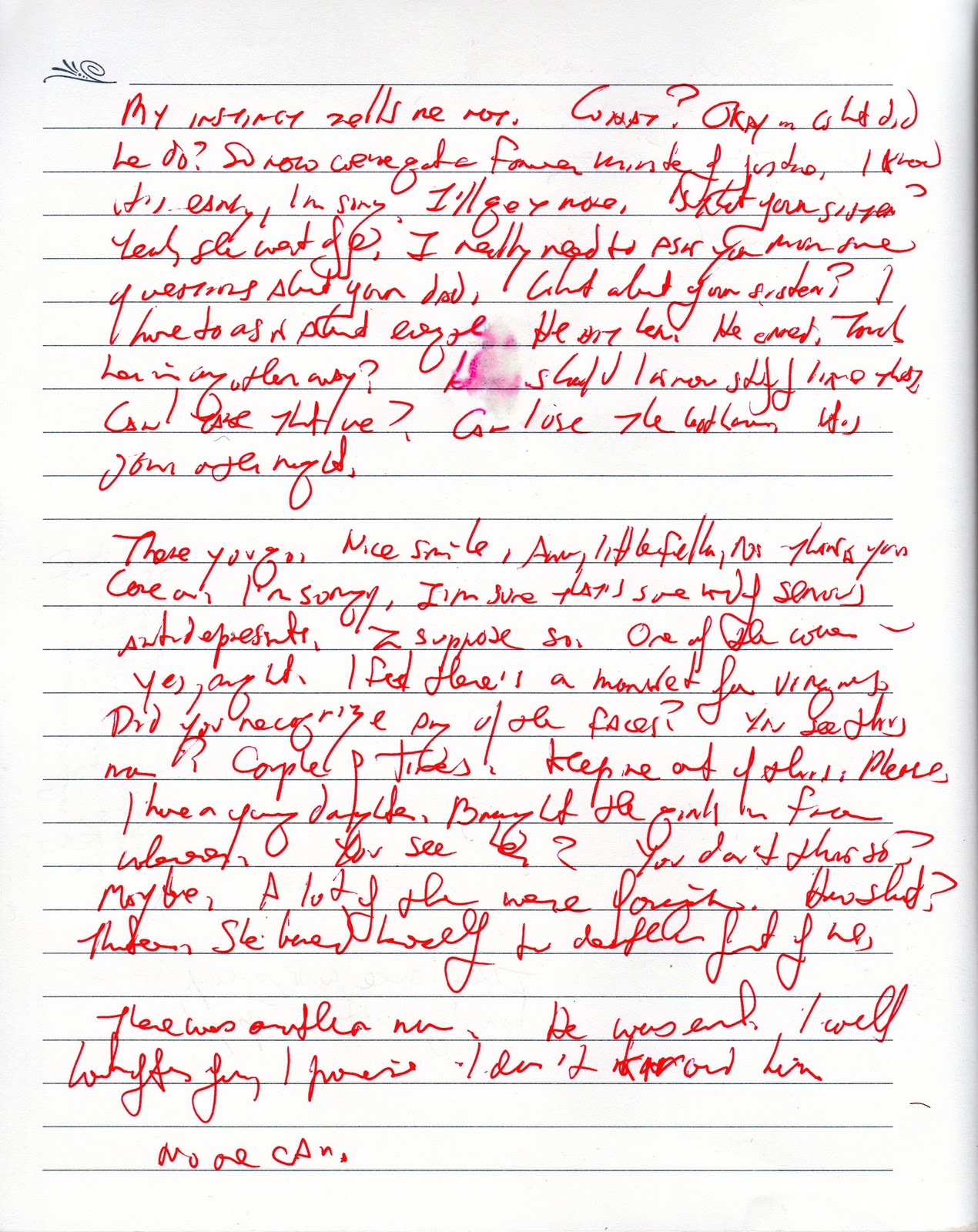
My instinct tells me not.  What?  Okay . . . what did he do?  So now we've got a [something] minute of justice.  I know it's early, I'm sorry.  I'll get more.  Is that your sister?  Yeah, she went off.  I really need to ask your mom some questions about your dad.  What about your sister?  I have to ask about everything.  He hit her.  He cried.  Touch her in any other way?  How should I know stuff like that?  Can I take that [something]?  Can I use the bathroom?  It's down on the right.
These young...  Nice smile.  Aww, little fella, [something], thank you.  Come on.  I'm sorry.  I'm sure that's some kind of serious antidepressant.  I suppose so.  One of the women -- yes, alright.  I feel there's a market for virgins.  Do you recognize any of these faces?  You see this man?  Couple of times.  Keep me out of this.  Please, I have a young daughter.  Brought the girls in from wherever.  You see her?  You don't think so?  Maybe.  A lot of them were foreign.  How short?  Thirteen.  She burned herself to death in front of me.
There was another man.  He was evil.  I will look after you, I promise.  I don't know her.
No one can.


Every now and then you have to take a steady look at what's going into your mind.  I was listening to something on TV and I wrote down the dialog as fast as I could, missing about half of it.  The resulting combo of banality and menace sounds a lot like a radio broadcast from Hell, doesn't it?

*

Sunday, August 7, 2011

APPEARANCES -- Sunday Update

.


I've added another appearance, the Wold Newton Reading Extravaganza in November, of which more as the time approaches.  And I've detailed my public appearances at Renovation.

I think I'll annotate my Worldcon schedule sometime later this week.


August 19-21   Renovation (Worldcon)
                         Reno, NV

Saturday
 Sat 11:00 - 12:00, Autographing: Michael Swanwick Sat 11:00 Hall 2 Autographs (RSCC)
Sat 12:00 - 13:00, The Craft of Writing Short Science Fiction and FantasyA SF or fantasy short story can be a sparkling jewel, making a long-lasting impact on the reader.  The story may be serious or comic, a pleasure to read or a tale that won't let you stop reading until it is done with you.  How does the writer craft effective short fiction?    What techniques help the writer achieve success?  We go beyond the "good idea" and discuss the craft of writing. 
Adam-Troy Castro (M), Jay Lake, Connie Willis, Michael Swanwick, Robert Reed
 Sat 14:00 - 15:00, SF: Yesterday, Today, and Tomorrow  (Dialog) A11 (RSCC) 
Two of SF's most award-winning writers discuss SF (and anything else they feel like touching on).James Patrick Kelly, Michael Swanwick
 Sat 17:00 - 18:00, Literary Beer: Michael Swanwick: Sat 17:00, Hall  Bar (RSCC)
 Michael Swanwick and Jack Skillingstead

Sunday
Sun 12:00 - 12:30, Reading: Michael Swanwick (Reading), A15 (RSCC)
Sun 13:00 - 14:00, Discussing Best Related Work (Panel), A05 (RSCC)
The Best Related Work category for the Hugo Awards can be anything about the field - from a humorous book about science to a biography or autobiography to a giant book about art.  The panel discusses this year's nominees.  Come and hear why you may want to pay more attention tothis fascinating category.
Farah Mendlesohn (M) Chris Garcia, Amy Thomson, Claire Brialey, Michael Swanwick, Stephen H. Segal

Sept. 10           The Spiral Bookcase (signing)
                         Manayunk
                         Philadelphia

Sept. 21            KGB Bar (reading)
                         NYC  

November 10    Wold Newton Reading Extravaganza (reading)

And in 2012 . . .

Aug. 31- Sept. 2   Chicon 7
                             Chicago


Above:  Miss Helen Hope Mrrrlees says, What are you looking at?

*

Friday, August 5, 2011

Reading Apollinaire's Bestiary

.


I do not argue that e-books will never replace the traditional book.  The advantages of being able to throw a few hundred books into your overnight bag are pretty well established by now.  Nor is it seemly for a man who makes a living from writing science fiction to wax overly nostalgic about the technologies of his youth.

But still.  There is a particular pleasure to a well-made book, and here's a case in point.  I am currently reading (and have been for some time) Guillaume Apollinaire's first collection of poems, The Bestiary: or Procession of Orpheus.  I have a particular fondness for bestiaries and for collections of verse, so this was a natural for me.  Also, I've never really gotten a handle on Apollinaire as a poet and I figured this was a good place to start.

The appeal of e-books seems to me chiefly one of efficiency.  You conceive a desire for a particular book and in less time than it would take to find the keys and back the car out of the driveway, your purchase is complete.  Rather than having to rattle through the house, searching through shelves and stacks of books, you simply boot up the reader and there the text is, at your fingertips.  These are undeniably good things.

Sometimes, though, you don't want efficiency.  The Bestiary is a collection of poems that are only four lines long.  You could barrel through it in fifteen minutes if you were willing to sacrifice  comprehension.  And yet.  The slim volume I have (from Johns Hopkins University Press) is designed for languorous reading.  The pages are thick, cream-colored stock, a mild pleasure to touch, and they are of slightly staggered lengths, so that one opens it at random to find a small treasure awaiting:  on the left-hand page, a single poem printed twice, first in the original French and then in English translation by X. J. Kennedy and on the right-hand page a woodcut by Raoul Dufy of the creature in question.  It is a book that as good as says, I am a complete waste of your time.  Come -- waste your time in my pleasant company.

It is when we are at our most inefficient that we enjoy life best.  I don't know how much of the book I've read yet.  But I'm sure that someday I'll pick it up and realize that I've read every poem it contains.  X. J. Kennedy also provides an explanatory essay at the beginning and I may get around to reading that too, someday.  Or maybe not, depending on my mood.

*

Scribbledehobbledehoyden: The Magpie's Eye: Page 152

.


To begin, a nonsense limerick in bad Platdeutsch:


Zwar einmal ein limerick
Das zweifal war gimmerick
Es plotz
Und zotz
Und immerfal dimmerick!

Then an article about Stephen Colbert and the dwindling of traditional news nedia, superimposed over a gorgeous drawing by R. Crumb.  What an eye that guy has!  How very hard he works!  Next to it I wrote:  Why can we not have a show of R. Crumb drawings -- those which are not cartoons?  Those which are not narrative?  I'd love to spend an afternoon wallowing in his line.


Finally, another piece of light verse.

There once was a couplet
for dogs -- 'twas a puplet!

*

Thursday, August 4, 2011

Telling Lies for Fun and Profit

.


I'm a professional liar.  It's not an easy skill to master, but it's one I take very seriously.  So I'm always on the lookout for ways of telling lies more effectively.

I picked up a copy of the Fiction 2011 issue of the Atlantic yesterday, and in it found two true statements about my craft.  The first, from an essay about the writer's fear of saying what has already been said by John Barth (whose Giles Goat-Boy was, many, many decades ago, the first big-and-difficult book I ever read) is a quote from Andre Gide:

Everything that needs to be said has already been said.  But since no one was listening, everything must be said again.

The second comes from an essay by Bret Anthony Johnson titled Don't Write What You Know.  Which, I must confess, had me at the title.  Here's what he wrote:

Instead of thinking of my experiences as structures I wanted to erect in fiction, I started conceiving of them as the scaffolding that would be torn down once the work was complete.

Which is just brilliant.  The critic Hugh Kenner once wrote an essay describing an incident in WWII wherein two agents of the French Resistance were sent on an important mission.  Given an absolute minimum of information, in case they were caught, and disguised as tramps, they made their way across the perilous countryside.  Only to discover at their dangerously open rendezvous point that their contact had been delayed but that, surely, Mr. Godot would be there tomorrow.  This, he said, was in all likelihood  the story that Samuel Beckett started with, before scraping off the particulars and making Waiting for Godot universal.


And rather to my surprise . . .

My own Stations of the Tide made NPR's list of the 217 best science fiction and fantasy books ever written.  Actually, they're compiling a list of the top 100 but that won't be announced for a few weeks yet.  And since my novel may fall off the list between then and now, I'm celebrating while I can.

Life is uncertain.  Not long ago a food writer for the Philadelphia Inquirer wrote of how his mother had died of a heart attack one day while making lunch.  He noted proudly that the piece of cake a neighbor had given her for dessert had already been eaten.
 
You can read about the list here.  Or you can go straight to the list itself here.


Above:  This quite good photo of me telling lies is copyright 2011 by Sally Wiener Gotta and is used here by kind permission of the photographer.