.
Sun 12:00 PM Autograph Table with Bjorn Hasseler & Anna Kashina
If you see me, be sure to say hello!
*
.
Sun 12:00 PM Autograph Table with Bjorn Hasseler & Anna Kashina
If you see me, be sure to say hello!
*
.
Another of my heroes has left the planet. It's been decades since I've seen Mike in person and, to my surprise, I find that on reflection we never spent enough time together that I could claim he was a friend. He was just a terrific writer whose work I admired. But he was such a warm and positive man that his loss hits hard.
In the wake of his death, I find myself thinking of when I first met him. That was when he was Principal Speaker at Philcon in 1978. He gave a speech then that was easily the most hilarious thing I have ever heard at a convention. It was filled with wisdom and sprinkled with news items from Locos, the version of Locus published in an alternate universe askew to ours. He had the audience in stitches.
Just before he went on, Mike impulsively borrowed the black cowboy hat Gardner Dozois wore back in his pre-Asimov's days. Then he announced that when he was wearing the hat, the words coming from his mouth were telepathically projected from Gardner's brain, and that when he wasn't, the words were his own. He then proceeded to employ every possible comedic variant from the idea. No professional comedian could have done better.
Fancyclopedia, which I checked to make sure I had the date right, called the speech "luminous."
That sounds about right. And so, I fancy, might one characterize his life.
And now he's gone. Have I mentioned that Bishop was a sincere Christian? If he was right in his beliefs, then he's in Heaven right now. That would be fitting. I'd applaud that.
He had the greatest smile ever.
*
.
"The Four Last Things" by Christopher Rowe. Asimov's Science Fiction, November/December 2023
Think of "The Last Four Things" as a postcard from the far side of the Singularity. Here's how it begins:
They came on a mule ship, and they lived on what was left of it after they arrived. The hull, laid down by poet-engineers in the high docks, was laminated from hundreds of thousands of layers of zepto-sec time and planck-length matter, each layer a gossamer capable of withstanding anything they could imagine. The controlling mule itself, like all its siblings, was spun up from archived biological remnants of a lost hybrid equine, integrated with specialized subsystems designed to travel between.
Yeah. It's not easy going, and it doesn't get any easier. But those of us who have been around long enough to acquire a taste for
difficult fiction will relish it. As will those readers young enough to be actively seeking out works that will challenge them. And of course those outliers who aren't supposed to get it, but will.
Oversimplifying wildly, here's the plot:
Four individuals--they may be "people" of some sort--have come to the planet Ouestmir on a voyage of discovery. There they find immortal five-meter long worms living in undersea volcanic vents and slamming themselves against the reefs that encase them--drumming, drumming, drumming. The purpose of this is unclear. But a pattern of flares and radio signals in their star's polar regions are clearly a kind of response.
An attempt to communicate with the worms inexplicably causes the death of every worm on the planet. The drumming stops. The responses from the star cease.
What the drumming meant and why the worms died is a classic science fiction puzzle that will not be solved. Because what "The Last Four Things" is about--as is signaled by a quote from James Joyce that gives the story its title--is the nature and meaning of death.
I fear many science fiction readers will find this story annoying and even incomprehensible. Others, however, will read and reread it with pleasure.
You know who you are.
*
Recently, Marianne and I went to the Eastern Shore for a few days of quiet relaxation, and by sheer good luck we discovered the Nace Hopklins Day Parade in Trappe, Maryland. Pictured above are reenactors representing Nace and his wife.
Nathaniel "Nace" Hopkins was born into slavery and, while still technically enslaved, enlisted in the Army and fought for the Union in the civil war. Upon his return home, he was instrumental in building the first school for Black children in the area and the incorporation of the Scotts United Methodist Church. He also began, in 1867, a yearly parade marking the 1864 emancipation of all enslaved people in Maryland. (Lincoln's Emancipation Proclamation, a year earlier, applied only the seceding states. The 14th Amendment was still a year away.) After his death in 1900, the parade was renamed in his honor.
As the man deserved. He was one of those people who built this nation.
So what was the parade like? Trappe is a small town, population roughly 1100, and the parade was everything good about small town parades. There were two high school marching bands, at least one children's dance group, about thirty Chevrolet Corvettes in gleaming condition (including one that Batman could only envy). Also various vehicles, including fire trucks. Lots of people threw out candy for the children.
Afterward, the local church had games, a bouncy castle for the children, prizes also for children, lots of food, and other entertainments. We didn't participate though it all looked like good fun. We'd already had the best of the event--being among the spectators and feeling the good will coming from them and directed toward them.
There are a couple more pics below. I didn't take many because I was enjoying myself too much.
*
.
Robert Morris Sr. was the father of Robert Morris, the founding father who was the "Financier of the Revolution." Marianne and I came upon the elder Morris's grave in Whitemarsh Cemetery during the course of our perambulations and have dutifully copied the words of praise inscribed upon his stone:
In memory of
ROBERT MORRIS a Native of Liverpool
In Great Britain
Late a Merchant at Oxford
In this Province
Punctual Integrity influenced his Dealings
Principles of Honor governed his Actions
With an uncommon Degree of Sincerity
He despised Artifice and Dissimulation
His friendship was firm, candid and valuable
His charity frequent, secret and well adapted
His Zeal for the Public Good active and useful
His hospitality was enhanced by his Conversation
Seasoned with cheerful Wit and a sound Judgment
Which about says it all. Save only that he also, though the stone does not admit to this fact, owned many human beings, whom he held enslaved. That fact should be entered into the ledger of Eternity as well.
Oh, and here's an odd moment in history . . .
In 1747, three years before his death by accident, Morris imported 106 indentured Scottish soldiers captured at the Battle of Culloden to work the tobacco fields of Oxford.
*
.
From the outside, it's just a nondescript brick building with a cool sign. But inside, Unicorn Bookshop in Trappe, Maryland, is everything a secondhand book store should be: eccentrically laid out in a labyrinth of small rooms that are crammed with a great variety of books--and, for a bonus, a map room on the second floor.
There is a separate room for notably old or autographed or first edition or particularly valuable books, but when I visit (once every so many years) I always start with the fiction shelves. The books are meticulously curated coming into the shop but after they've been shelved...not so much. Some have been there so long they've drifted away from their original placement. A novel by Richard Harding Davis is shelved beside James Branch Cabell. Here and there are non-fiction books with titles suggesting that they're novels and collections of poems by writers better known for their prose.
All this makes hunting for books that much more exciting. Recently, a friend lamented that online book buying meant that there was no longer any reason for him to go to bookstores. But if I hadn't dropped in, would I know that I needed a copy of Ben Hecht's One Thousand and One Afternoons in Chicago? I'd never heard of it. Or a paperback (headed, ultimately, for our Little Free Library) of Kipling's Rewards and Fairies, a sequel to his far more famous Puck of Pook's Hill?
I seriously doubt it.
So, yeah, I recommend you spend a long, rainy afternoon there sometime. The books are reasonably priced, there are comfy chairs here and there in the shop, and the proprietor is a genial man. Time spent there is time well wasted.
Oh, and in the general fiction section are two copies of my Jack Faust in hardcover, not at all expensive, which I autographed the last time I was there, a year ago. Would somebody please go and buy them? They're depressing the hell out of me.
Oh, and . . .
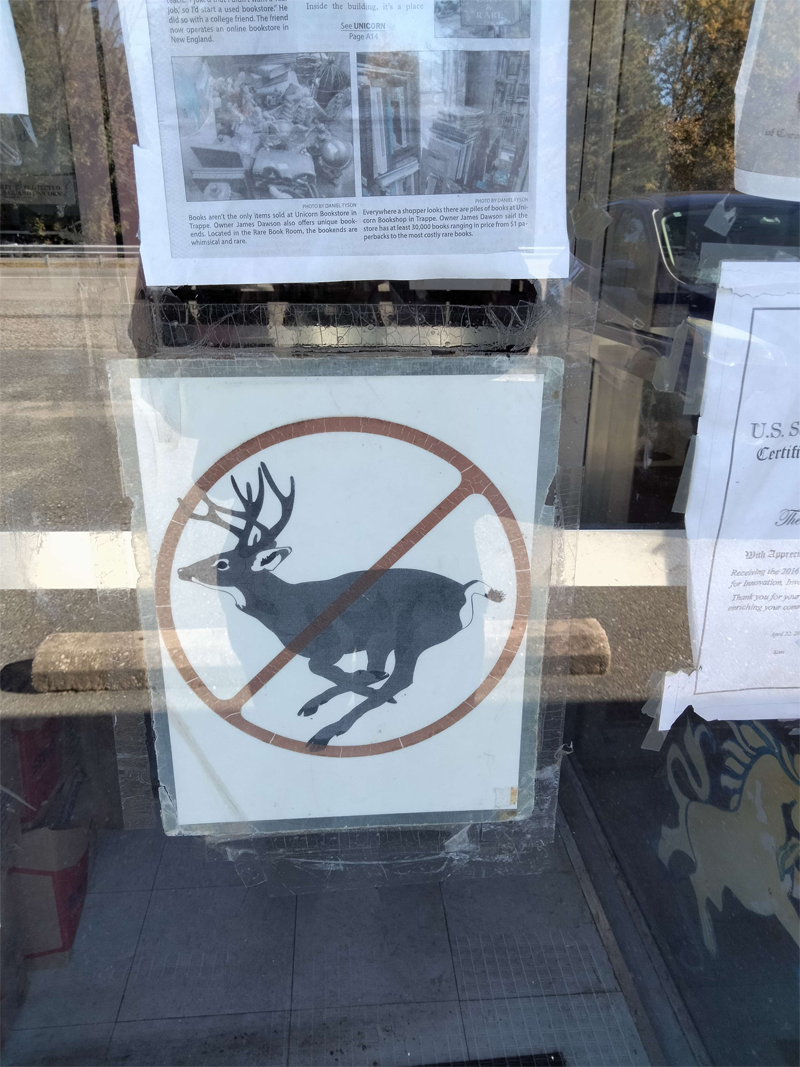
Here's a photo of the door to the bookstore. Wondering why there's a Universal No Deer sign on it? You can read the entire amazing story here. Immediately followed by a poem chronicling the event, for those who won't believe anything unless it's put into verse.
*
For those who couldn't keep up with a month's worth of leaf-reading, here's the text of this year's Halloween story:
Under a Harvest Moon
by
Michael Swanwick
(with Marianne Porter)
Guilt-ridden, sorrowful, the mourner came to their cemetery. Because both the living lover and the dead were goths, this was at midnight on Samhain.
Strewing dead roses on an all-too-new grave, the mourner said, “We argued, it’s true. I have a temper. So did you. But no one could deny our passion, our mutual need, our love.”
Silence.
At last, the mourner turned away.
A bony hand burst out of the dirt and seized the mourner’s ankle in a grip like iron. With a scream, the mourner fell backward, pulling the hand after, and an arm up to the elbow as well.
Kicking away from the unholy assailant with all available strength, the mourner slowly and unwillingly dredged all of an arm and a shoulder out of the soil. The arm was brown and its muscles like leather.
“Oh, please!” the mourner sobbed. “No! Don’t!”
A head emerged from the grave dirt and after it, another arm. Now the lich was using its own strength in tandem with the mourner’s to free itself from the grave.
One thrawn hand released the ankle even as another seized a knee. Hand over hand, the corpse pulled itself into the realm of the living. And then raised up the mourner so they were standing chest to chest.
The lich wrapped its arms around the mourner. Its flesh was rotting. Its nose was gone. One eye had succumbed to putrescence. Bits of skull were exposed. But there was no mistaking that face.
Weeping, for remorse drowned out fear, the mourner said, “I didn’t mean for it to haen. O Yes, it was my fault. But—”
“Hush.” The lich’s face came within an inch of the mourner’s. Its breath stank of rotting tongue. “That doesn’t matter.”
It wrapped tough, unbreakable fingers around the mourner’s throat. “Here’s what matters I cannot die without you. Can you live without me? Say yes, and I will release you. Say no and you will die.”
“No!” the mourner cried. “Oh, please, no! However dire and fearful death may be, I choose to share it with you. Take me there.
Take me now.”
*